︎

Matthias A. Peterseim


show drawings
show films
jump to introduction
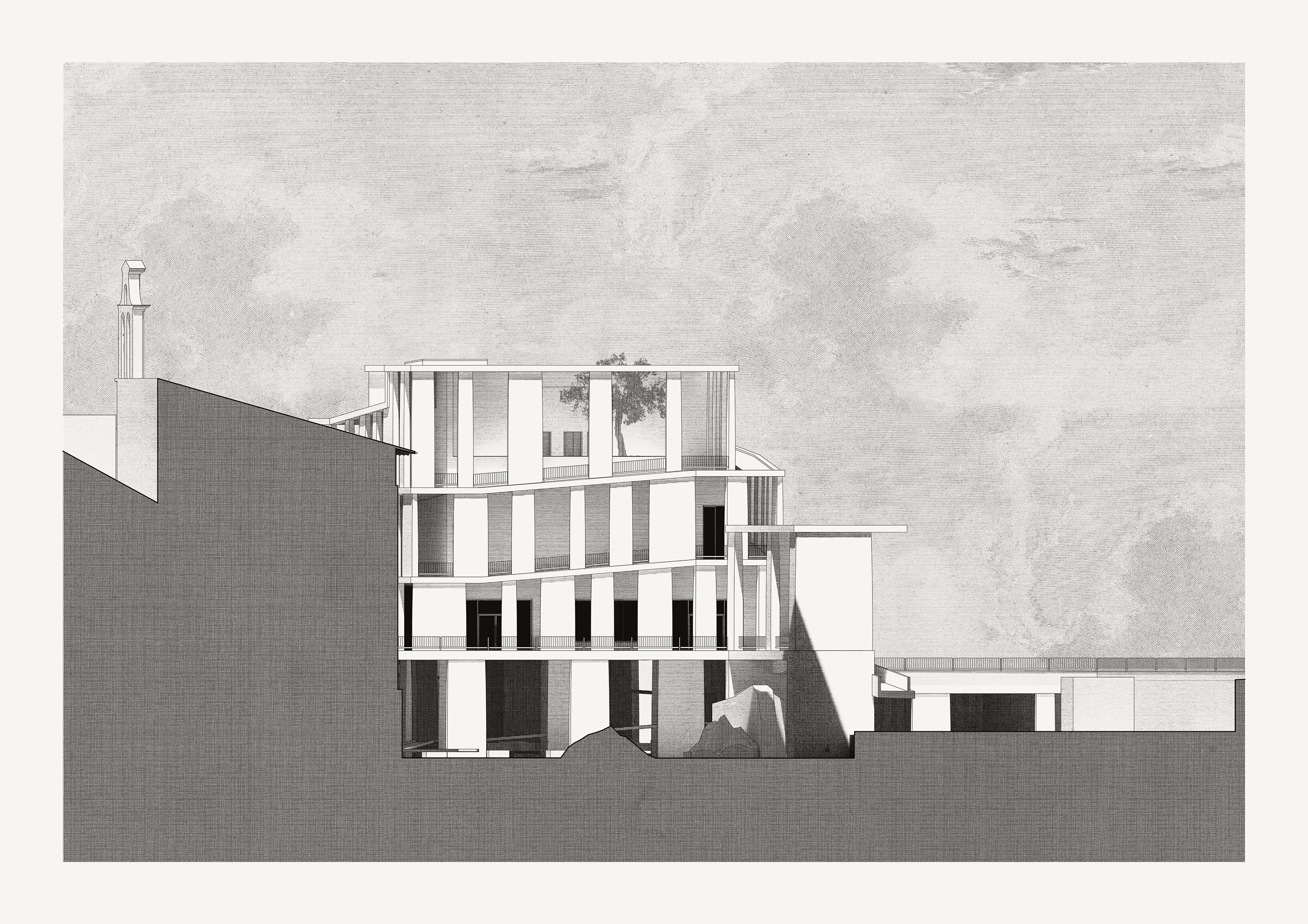
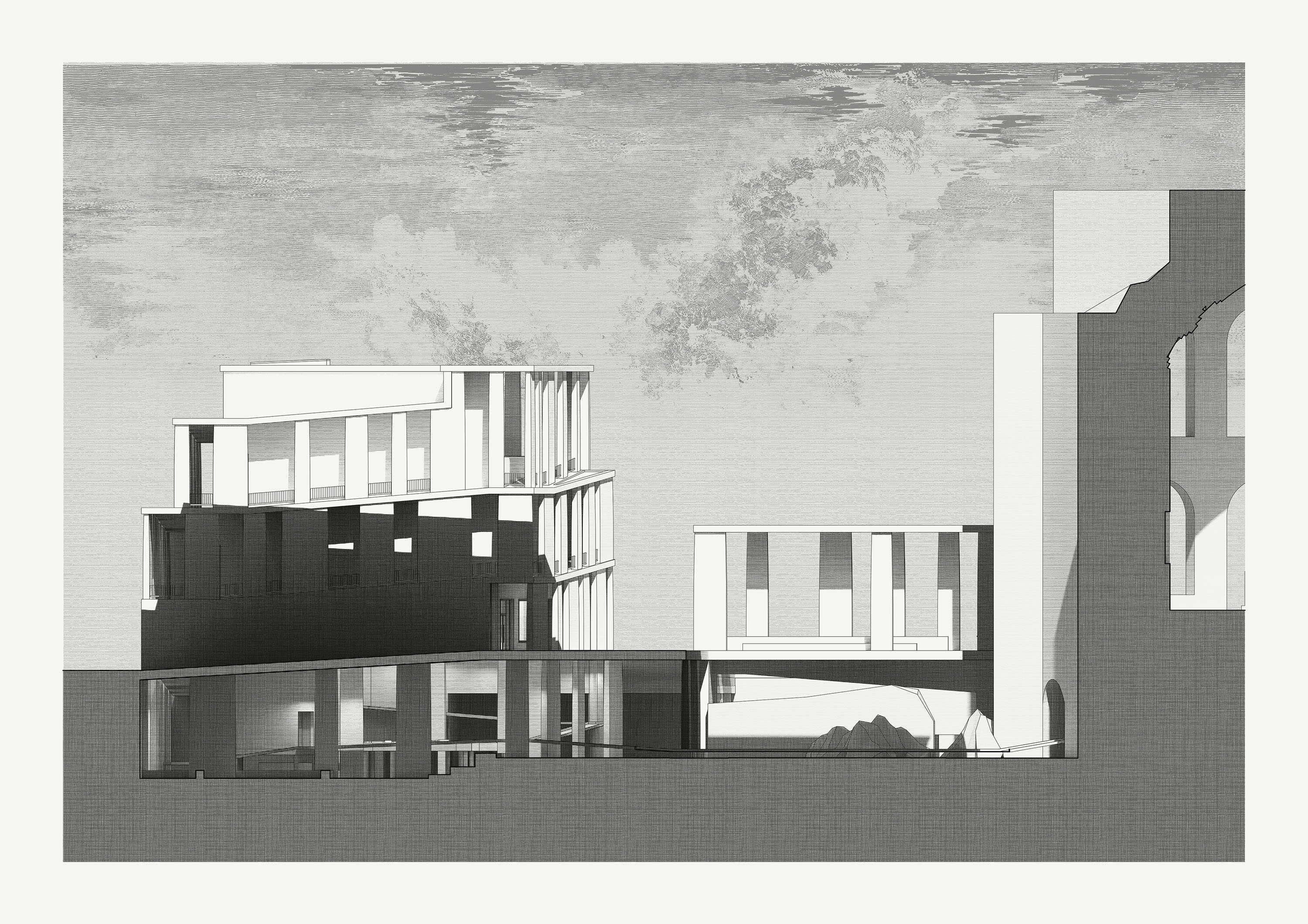
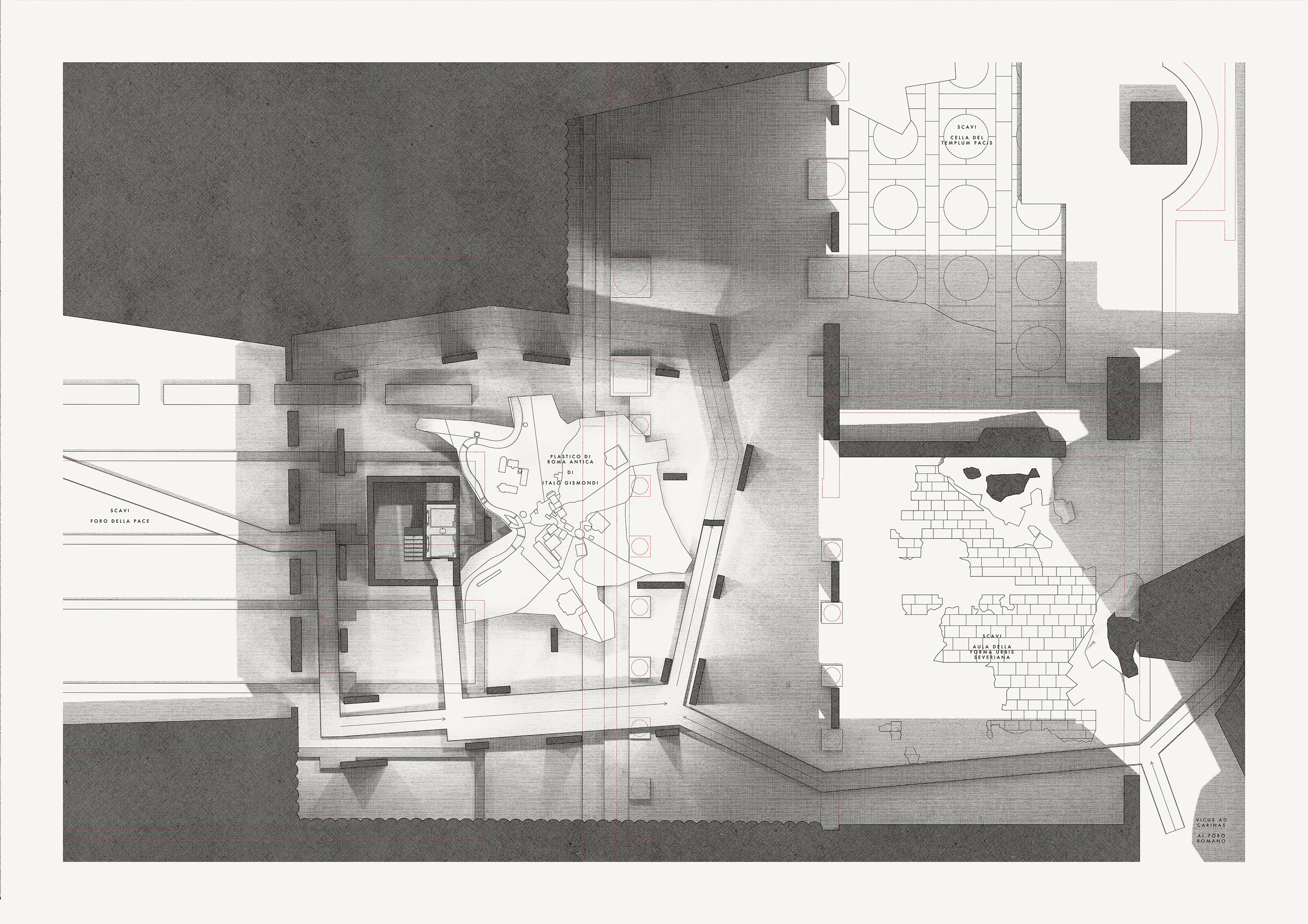
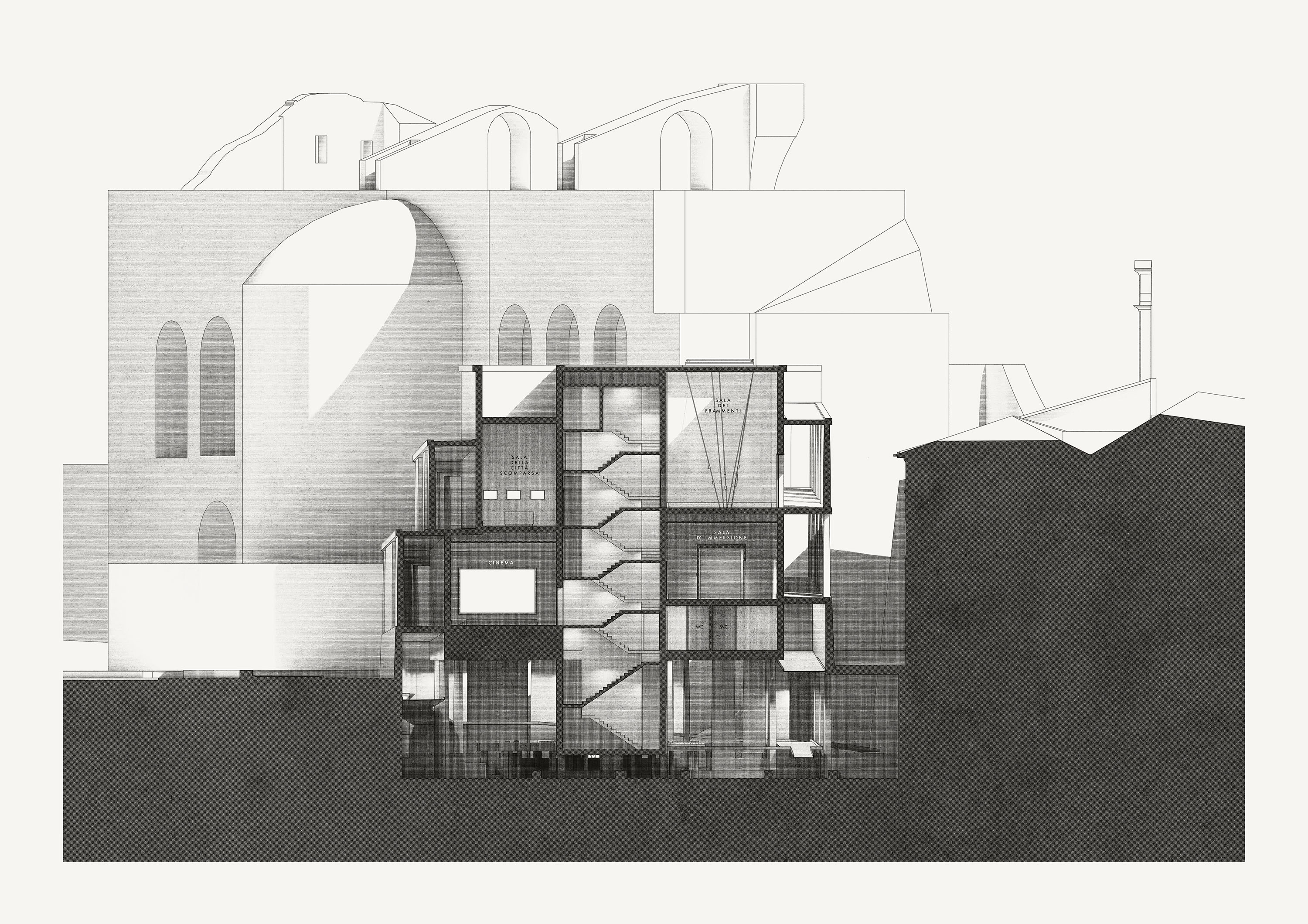
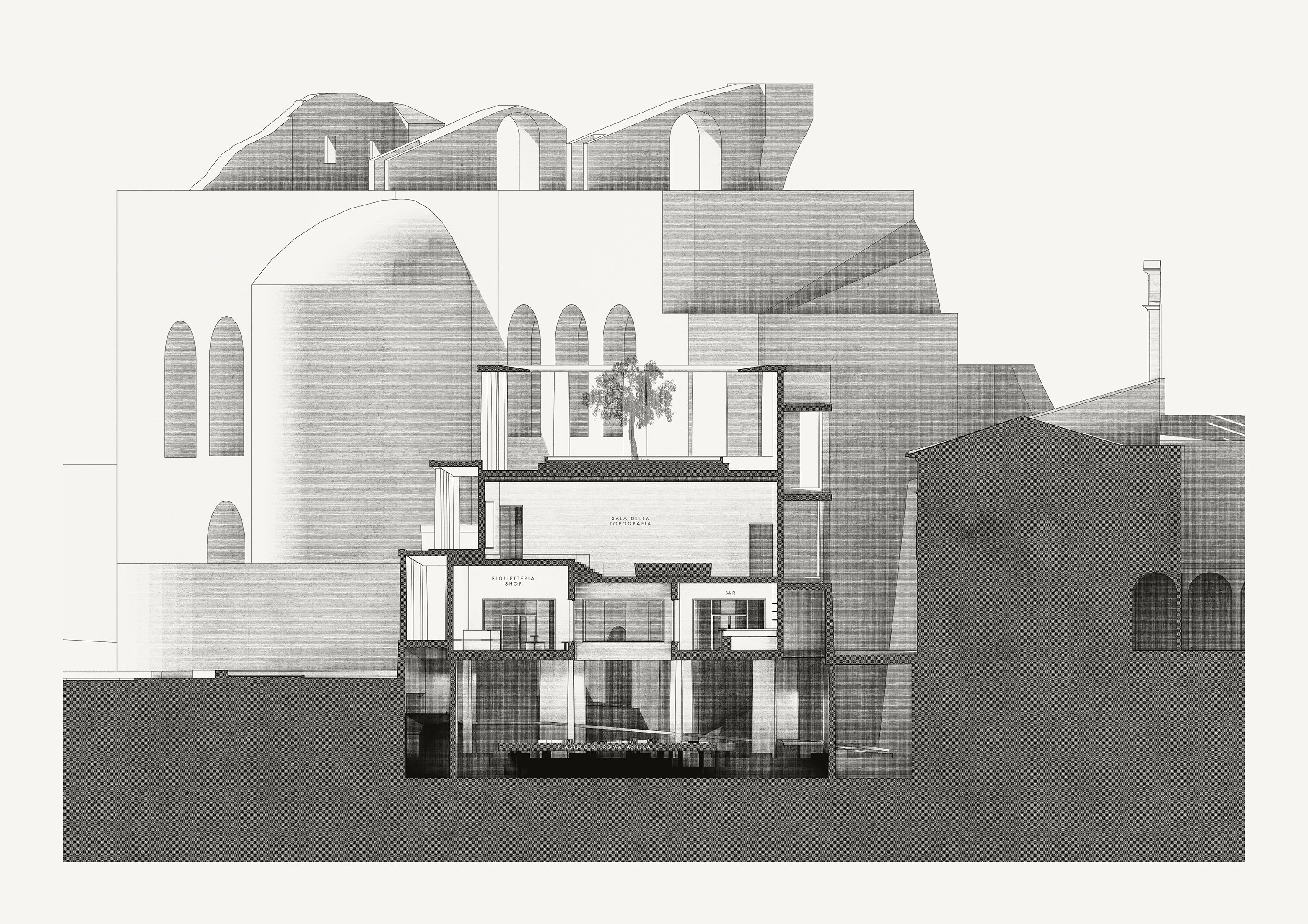
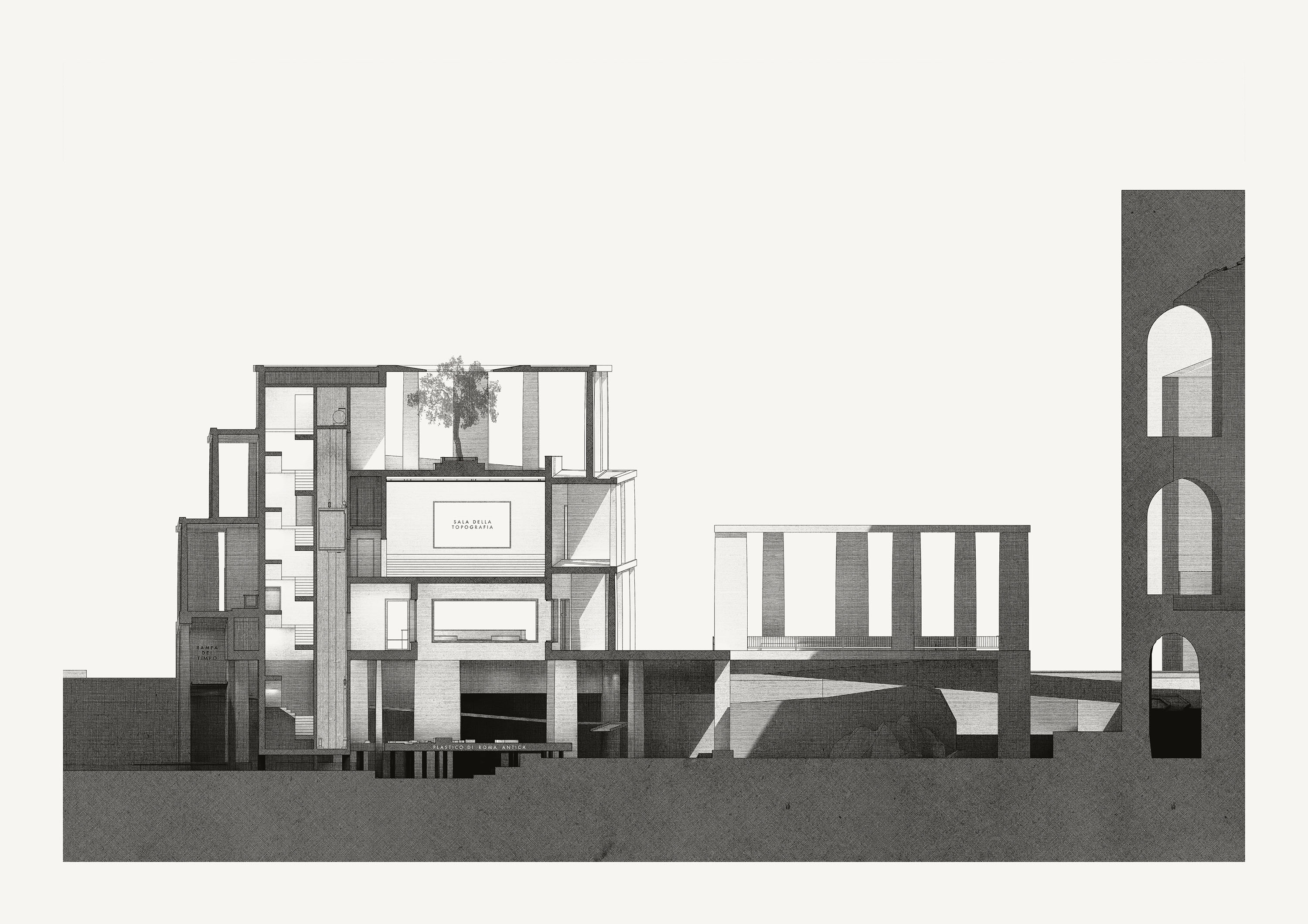
NW: In the foreground/below, the excavations of the Foro della Pace. In the background, the late roman Basilica of Maxentius. To the right, the convent of SS. Cosma e Damiano. The body of the Museum extends vertically to the antique roman layer where the excavations run through the Museum's underground level. SO: Piazza-Façade. In the foreground/below, the excavations of the former Aula of the marble map at the Foro della Pace with the new Loggia above it looking to the original wall with the reconstructed Forma Urbis Roman map. To the left, the Basilica SS. Cosma e Damiano. SW: Alley between the Museo della Forma Urbis and the convent of SS. Cosma e Damiano. To the right, the Loggia facing the marble map and to the far right the massive Basilica of Maxentius. In the underground, the excavations of the Foro della Pace with Italo Gismondi's model "Plastico di Roma Antica" placed in the underground level of the Museum (accessible via the ramp or the surrounding excavation paths). Underground/Roman level. Excavations of the Foro della Pace (71-75, 192 a.D.), reconstruction of the ancient structure in red. The Museum, Loggia and the Piazza lie above. The ramp grants access to the excavations and to Gismondi's model of Ancient Rome (see sections). In the top right corner, the former Cella of the Temple of Pax with marble floors in "opus sectile". Below, the former Aula where the marble map was installed (only parts remain). In the lower right corner, the "Vicus ad Carinas", an ancient alley that leads from the Roman Forum to the suburbs. It traverses the foundations of the Basilica of Maxentius, which was added in late antiquity. The vault is known as "Arco del Latrone" and was reopened in 2018. Ground floor/today's street level. Reconstruction of the Foro della Pace in red. The new piazza SS. Cosma e Damiano is confined by the 30ies portal of the Basilica SS. Cosma e Damiano (bottom-center), the Museo della Forma Urbis (left), the Loggia della Pianta Marmorea (center-right), the Basilica of Maxentius (lower right edge) and finally the Forma Urbis itself on SS. Cosma e Damiano's back wall (bottom right facing the Loggia). The Piazza is accessed by the steps from the grand Via dei Fori Imperiali. A small alley behind the museum leads alternatively to the plateau. The Museum's ground floor serves the Piazza with its shop/ticket office and a classic bar. Also, a window in the public hallway lets visitors glance at the large model below (see sections). The Loggia facing the marble map is completely public, walkable during day and night. This way, the ancient archeological piece is integrated into the public cityscape. Mid horizontal section. Along the ramp follow a cinema, the Sala d'immersione and the Sala della Topografie, which shows historic and contemporary views and maps of Rome. The ramp offers manyfold views around the Roman cityscape and performs as a mediator between the fictional and rational exhibits on the inside and the actual urban fabric outside. Upper horizontal section. The next halls are the Sala della Città Scomparsa, which looks at the lost parts of the city due to excavation activities; the Sala dei Frammenti, showing fragments of the FUR that could not be placed on the original wall due to unknown positioning; The end of the ramp, a roof garden exhibiting original marble sculptures and findings from the area under the direct Roman sunlight. Visitors may use two elevators to return to the Piazza level. Vertical Section III: In the underground, the Foro della Pace excavations (71-75, 192 a. D.). The large model by Italo Gismondi in the museum’s underground level shows the Ancient Rome around 300 a. D. in a 1:250 scale. It was built on occasion of the „Mostra Augustea della Romanità“ in 1937 commissioned by Mussolini and updated according to scientific discoveries until the 1970s. Being actually exhibited outside the city center in the Museo della Civiltà Romana in EUR it rarely receives public awareness. Also, the mentioned Museum was closed to the public in 2015. An Oslo University researcher, Victor Plahte Tschudi, suggests in his essay on this gigantic model, that the fascist regime used it to legitimize its rationalist urban planning by integrating such quarters into the model where no information on the original cityscape was available. Nevertheless, the Plastico di Roma Antica represents one of the most detailed spacial depictions of one-million-inhabitants ancient Rome to date. Contrary to the original musealization in EUR, in which visitors view the model only from great distance and therefore could not really recognize the precisely modeled city centre, at the Museo della Forma Urbis, the model’s center can be publicly looked at from the Piazza level through a window. The museum’s outer ramp also leads to the underground level where the model can be seen from close distance. It is protected by a glass enclosure. Vertical Section II: All internal exhibition halls are positioned next to and on top of each other along the outer ramp from which they are accessed. The halls have varied lighting situations matching the exhibits requirements and are placed vertically accordingly. This complex reinforced concrete structure sits on numerous pillars that are placed in the area of the former Foro della Pace. The exterior is cladded with roman travertine: Large, uniform panels for the flooring, roof edges and embrasures; A wild bond consisting of many different formats for the outer walls and the peristasis’ pillars. The outer soffits and inner halls are plastered and painted. The steel railings are painted in a travertine-like colour to support the feeling of an open, non-reflecting structure. Travertine is a traditional roman material as well as a local and natural one, coming from the nearby quarries in Tivoli for thousands of years. As one observes in many roman structures, travertine pieces have been re-used for centuries. Its quality consists not only in a high durability but also in its haptic and optic uniqueness: The white-beige surface subtly takes on the nuances of surrounding, strongly lit façades, as well as the sky’s blueish colour. This effect results in a gentle polychromy that changes depending of the time of the year and day. Vertical Section I: The Museo della Forma Urbis is a dynamic building. The outer, ascending walkway works like a promenade that suggests a certain direction of movement: Upwards. Even though the tour is conceived in a linear way, the internal exhibition halls serve like pauses in this linear upwards movement. The architectural experience along this walkway, which opens up while moving upwards, is a continuum while the internal halls contrast to it. The roofgarden of sculptures is a rewarding destination after moving up the ramp. It is most open, directly lit and offers the opportunity to rest before returning to the Piazza via the two elevators.  The Loggia facing the marble map is always open to the public. Its pillars toward the Via dei Fori seem like a filter for the adjacent Piazza. The other side offers an unobstructed view at the Forma Urbis marble map. This view is framed by the surrounding buildings (The Maxentius Basilica and the Museum). The ramps on the city-side lead to the Vicus ad Carinas, an ancient path to the Roman Forum passing through the „Arco del Latrone“ in the foundations of the Basilica of Maxentius.  The staircase ranges from the ancient level up to the roofgarden and serves as an escape route. All installations run along this vertical axis up to the technical area on top of the Hall of the los City. NO: The new piazza SS. Cosma e Damiano is reached by the stair in the center between the Museum (right) and the Loggia (left). Below, the excavations of the Foro della Pace (71-75, 192 a.D.). To the left the large Basilica of Maxentius (308-312 a.D.). To the right the church S. Lorenzo in Miranda (7. century a.D.) in the former Temple of Antoninus and Faustina (141 a.D.). In the background, the Basilica and convent of SS. Cosma e Damiano (495-525 a.D.) with the newly reconstructed Forma Urbis Romae (203-209 a.D.) at its original site.
about
contact
instagram